




Introduction
Given the severe shortage of donor liver grafts, the role of precise preoperative risk stratification is crucial to select a recipient who gains the greatest survival benefit from liver transplantation (LT) surgery. With improved surgical techniques and anesthetic management, cardiovascular disease is now the leading cause of early mortality following LT [1]. As a consequence, there is an increasing need for exact tools to evaluate cardiovascular risk in LT candidates [2,3]. However, the current model for end-stage liver disease (MELD) scoring system does not reflect any cardiovascular markers in its calculation. Since the era of MELD scores started in 2002, it allowed more objective prediction of 90-day mortality and improved prioritization of LT candidates [4], but it has remained barely unchanged for the last 20 years despite the ongoing need for revision [5]. Moreover, current noninvasive tests, such as dobutamine stress echocardiography and myocardial perfusion scan, which are mainly for detecting subclinical coronary and myocardial disease, do not have satisfactory performance in predicting postoperative outcomes [6].
Cardiac biomarkers, including B-type natriuretic peptide (BNP) and cardiac troponins, have been recognized for their powerful prognostic ability [7-9]. Guidelines on preoperative cardiovascular risk assessment recommend measuring BNP and cardiac troponin in patients scheduled for high-risk non-cardiac surgeries [10,11]. Troponin and BNP are reported to be correlated with severity liver disease [12], and a few studies have demonstrated the relevance of pre- and intraoperative elevated levels of these biomarkers in predicting LT outcome. Nevertheless, comprehensive combined interpretation of these two biomarkers and optimal cut-off values for LT candidates are still not established. For example, several studies employ just the 99th percentile upper reference limit (URL) of high-sensitivity troponin I (hsTnI), which has been used for healthy reference population [13,14], without consideration of particular cardiovascular characteristics such as a hyperdynamic circulation and the severity of illness in LT candidates.
Thus, we conducted this study to investigate whether elevation of cardiac strain indicated by a high BNP and accompanying subclinical myocardial injury assessed by hsTnI predict early mortality after LT. If so, the combined use of two cardiac biomarkers would help to improve preoperative risk stratification of LT candidates.
The objectives of the current study are (1) to determine any association between preoperative cardiac troponin and BNP in LT candidates, and (2) to define preoperative threshold of each biomarker that could predict short-term (90-day) mortality to assess the prognostic usefulness of these biomarkers, alone and in combination, in LT recipients.
Materials and Methods
Study Population
This retrospective study was approved by the Institutional Review Board of Asan Medical Center (2019-0824). A total of 2,949 consecutive patients who underwent adult LT from January 2010 to January 2018 were reviewed. Of these, we excluded patients whose preoperative troponin I and BNP were not measured within a week before LT (n = 374) and those who underwent re-transplantation or multi-organ transplantation (n = 85). We included patients with a previous history of coronary artery disease (CAD), treated with percutaneous coronary intervention or coronary artery bypass surgery, to determine whether preoperative ischemic heart disease is a prerequisite for hsTnI release and portends a poorer survival rate during the early post-LT period.
Measurement of Troponin I and brain natriuretic peptide
Both cardiac markers, hsTnI and BNP, were routinely measured preoperatively as part of the institution’s routine protocol since 2010. Cardiac hsTnI was measured using ADVIA Centaur® XP TnI-Ultra (Siemens Healthcare Diagnostics, USA; the 99th percentile URL = 40 ng/L, lower limit = 6 ng/L). Plasma level of BNP was measured using ADVIA Centaur® CP Immunoassay System (Siemens Healthcare Diagnostics, USA). We only approved cardiac biomarkers that were measured within a week before LT or just before induction of anesthesia for LT. If there were multiple measurements of cardiac biomarkers, the latest sample before LT was used for analysis.
Data collection and definition of outcomes
Data collection was performed using a fully computerized Asan Medical Center research information system (ABLE, Asan BiomedicaL rEsearch) after approval from the local research ethics committee (protocol number 2019-0881), which waived the requirement for written informed consent. This included patient demographics, medical history, MELD score of liver cirrhosis severity, laboratory variables, comorbidities of liver cirrhosis, and mortality. Patient survival time was defined as the number of days between the day of surgery starting in January 2010 and ending on March 31, 2018 or the date of death (completed). Mortality data were obtained from patients’ electronic medical records and the Asan LT registry, which is regularly updated by the Asan Organ Transplantation Center. The primary end point was the cumulative 90-day all-cause mortality and secondary outcomes included cumulative overall mortality during the entire follow-up period.
Statistical analysis
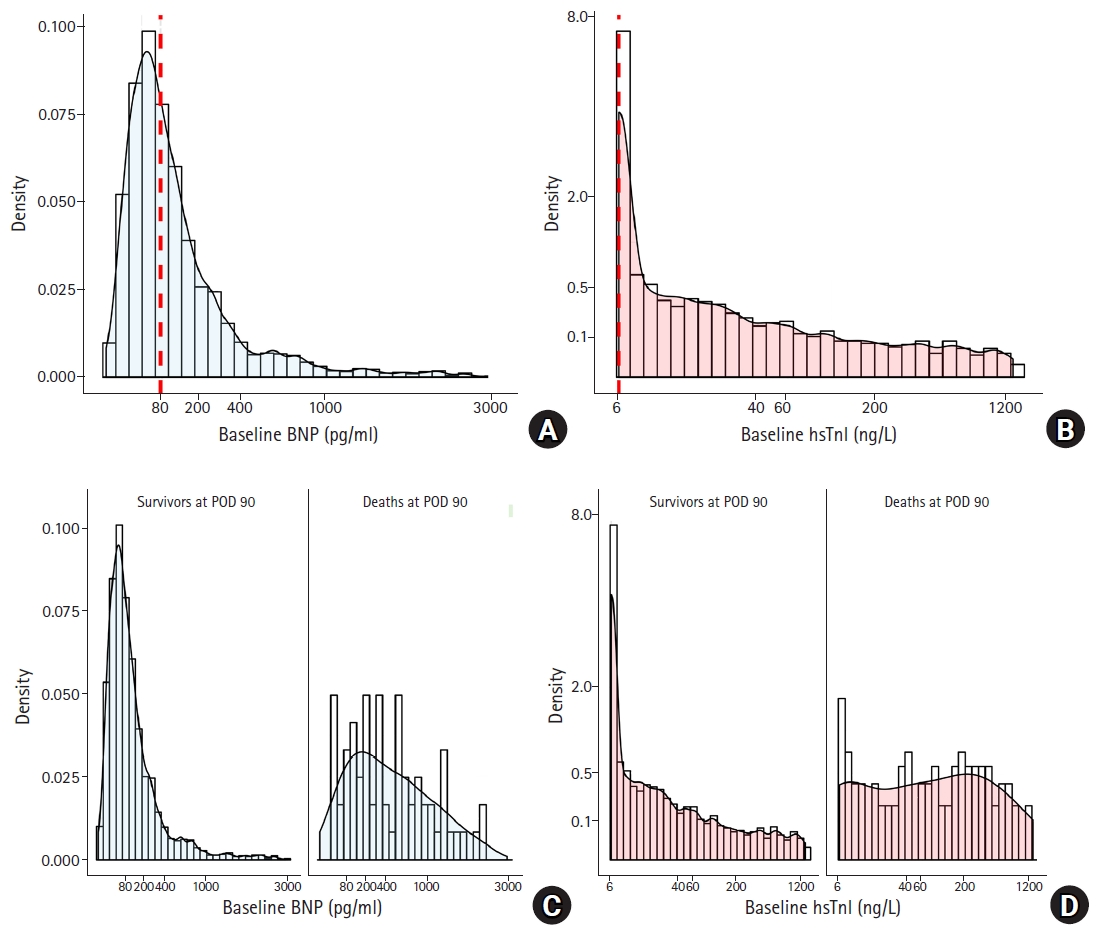
Variables are expressed as numbers (percentages), mean ± standard deviation, or median (Q1, Q3) as appropriate. Analyses between groups were performed using Student’s t-test, Mann–Whiney U test, analysis of variance, or Kruskal–Wallis test for continuous variables and χ2 test or Fisher’s exact test for categorical variables, as appropriate. Distribution of BNP and hsTnI were evaluated with a histogram and a density plot according to patient survival. To assess the relationship between preoperative hsTnI and BNP values, they were log-transformed and depicted on a scatter plot and analysis of covariance was performed to evaluate the association between the two cardiac biomarkers and patient mortality.
Optimal cut-off points of each cardiac biomarker for 90-day mortality and overall mortality were calculated using the ‘maxstat’ package of R (version 3.3.1, R foundation for statistical Computing, Austria). Briefly, using maximally selected rank statistics, the prognostic cut-off point was determined by evaluating every possible cut-off point, classifying all patients into two groups according to their level, and selecting the most discriminating threshold for death, corresponding to the minimum P value according to the log-rank test [15,16]. The main difference of maximally selected rank statistics from classic receiver operating characteristic curve analysis is that there is no need to change a time-dependent endpoint (survival) into a classification variable [16]. In receiver operating curve analysis, investigators have to transform the time-dependent end point (survival) into a binary end point that is clinically relevant (e.g., survival at certain time point). Using the ‘maxstat’ package of R, maximally selected rank analysis for finding cut-off values that discriminate survival curves (time-dependent endpoint) can be done easily. Following this analysis, patients were dichotomized using these cut-off values and then patients were further divided into three groups using a combination of both cut-off values: both decreased, either one elevated, and both elevated. The three groups were evaluated by Kaplan-Meier analysis with log-rank test (Mantel-Cox), and its independent prognostic role was evaluated with the Cox regression model. The derived hazard ratios (HR) were adjusted by established risk factors reported from previous studies. Those factors included age [17], sex [18], deceased brain death donor or living donor LT [19,20], hepatic encephalopathy [21], massive transfusion (intraoperative transfusion of packed red blood cells > 10 units) [22], renal replacement therapy [23], MELD score, and C-reactive protein [24]. Donor age and height, cold/warm ischemic time, and graft-to-recipient body weight ratio were also included as covariates for donor risk factors [17,25–27]. We further performed a subgroup analysis by MELD score of 15. Kaplan-Meier curves were further stratified using a MELD score of 15 to observe the effect of liver disease severity.
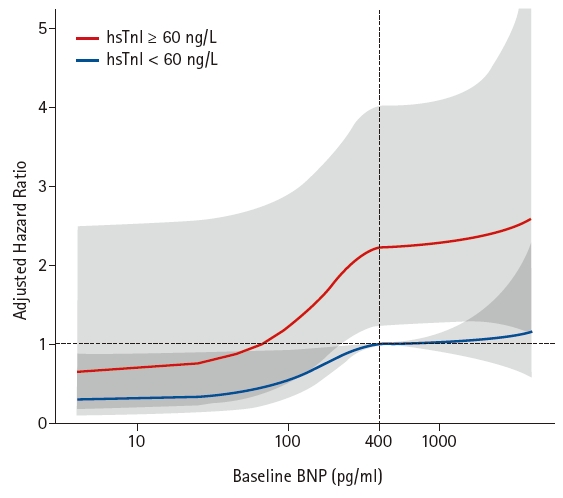
Cubic spline interpolation was performed to represent the continuous changes in risk of 90-day all-cause death according to BNP and hsTnI values; three knots were considered. The BNP for which hazard ratio was equal to unity was chosen at the optimal cut-off value of BNP.
P values < 0.05 were considered statistically significant. All statistical analyses were performed using R software version 3.3.1.
Results
Baseline characteristics
Of the 2,490 included patients of aged 20-78 years, 2,122 (85.2%) underwent living donor and 368 (14.8%) underwent deceased brain death donor LT (Table 1). The patient population consisted of 1,843 (74.0%) men and 647 (26%) women, of median age 54 years (48–59) and a median MELD score of 14 (9–24). The primary causes of liver disease were hepatitis B or C virus-related liver cirrhosis (LC, 62.9%), alcoholic LC (21.8%), and others (15.3%).
During a median follow-up of 2.9 years (1.3, 4.9), 221 (8.9%) patients died after LT, including 72 (2.9%) who died during the first 90 days. Cardiovascular-related death comprised 24.9% (55/221) and 30.6% (22/72) of overall and 90-day mortality causes, respectively. Baseline characteristics of all patients are depicted in Table 1.
Preoperative BNP concentrations
The BNP histogram of the 2,490 enrolled patients is shown in Fig. 1. The median level of preoperative BNP was 80 pg/ml (39–178) and 1,044 (42%) had BNP > 100 pg/ml [28,29]. Patients who died within 90 days had significantly higher BNP values compared with those who survived for at least 90 days (median, 455.5 vs. 77.0 pg/ml, P < 0.001). With maximally selected rank statistic for the prediction of 90-day and overall mortality during the entire follow-up period, best cut-off values of BNP were 325 pg/ml and 442 pg/ml, respectively; therefore, we rounded them off to 400 pg/ml, which is an already well-known cut-off value associated with mortality risk [30]. When dichotomized with these cut-off values, patients with BNP ≥ 400 pg/ml (n = 273, 11%) had higher MELD scores (median, 34 vs. 13, P < 0.001). The 90-day mortality rate differed using a cut-off value of BNP of 400 pg/ml (1.6% vs. 13.6%, P < 0.001), with corresponding crude HR of 9.14 (95% CI, 5.75, 14.50, P < 0.001) and adjusted HR of 2.02 (95% CI, 1.15, 3.52, P = 0.014, Tables 1 and 2).
Preoperative hsTnI concentrations
The frequency histogram of the hsTnI of the 2,490 enrolled patients is shown in Fig. 1. The median level of preoperative hsTnI was 6 ng/L (6, 160). A total of 1,463 (58.8%) patients showed normal hsTnI concentration of 6 ng/L, which is the lowest detectable value in the current study; therefore, 1,027 (41.2%) patients’ hsTnI exceeded 6 ng/L. Of 2,490 patients enrolled, 683 patients (27.4%) had levels between 7 ng/L and the 99th percentile URL (= 40 ng/L), 344 patients (13.8%) exceeded the 99th percentile URL (> 40 ng/L), and 272 (10.9%) had 1.5 times (> 60 ng/L), 133 (5.3%) had 5 times (> 200 ng/L), 84 (3.4%) had 10 times (> 400 ng/L), and 28 (1.1%) had 30 times the 99th percentile URL (> 1,200 ng/L), respectively.
Non-survivors within 90 days had significantly higher hsTnI values compared with survivors (median, 95 vs. 6 ng/L, P < 0.001). The best cut-off values of hsTnI for patients who died within 90 days and those who died during the entire follow-up period were 65 ng/L and 62 ng/L, respectively. Although the primary end-point of the current study is the 90-day mortality, these two cut-off values are very similar; therefore, we rounded them off to 60 ng/L, which is 1.5 times 99th percentile URL. When dichotomized with these cut-off values, patients with hsTnI ≥ 60 ng/L (n = 272, 10.9%) had higher MELD scores (median, 34 vs. 13, P < 0.001). The 90-day mortality rates according to a cut-off value of hsTnI of 60 ng/L were 1.4% and 15.1% (P < 0.001), with corresponding crude and adjusted HRs of 11.65 (7.31, 18.58; P < 0.001) and 2.65 (1.48, 4.74; P = 0.001), respectively (Tables 1 and 2).
Relationship between hsTnI and BNP
There was a significant correlation between BNP and hsTnI (r = 0.567, P < 0.001) in all patients, and non-survivors showed more correlation between BNP and hsTnI compared with survivors (r = 0.686 vs. 0.472, interaction P < 0.001, Fig. 2). The proportion of patients with hsTnI plasma level ≥ 60 ng/L was 50.9% in the subset of patients with BNP ≥ 400 pg/ml and 6.0% in the subset with a BNP < 400 pg/ml (P < 0.001).
Patients with history of coronary artery disease
Patients with a previous history of CAD (n = 29, 1.2%) had slightly higher baseline hsTnI concentration [15 ng/L (6-47) vs. 6 ng/L (6-16), P = 0.004], but the proportion of patients with hsTnI ≥ 40 ng/L (27.6% vs. 13.9%, P = 0.063) was not statistically different compared with the patients with no known history of CAD. Additionally, baseline BNP concentration in patients with CAD was not significantly different compared with those without a history of CAD [73 pg/ml (52, 198) vs. 80 pg/ml (39, 178), P = 0.901]. Furthermore, 90-day mortality (3.5% vs. 2.9%, P = 0.999) and overall mortality during the entire follow-up period (8.9% vs. 6.9%, P = 0.961) were similar.
Mortality according to the BNP and hsTnI cut-off values in combination
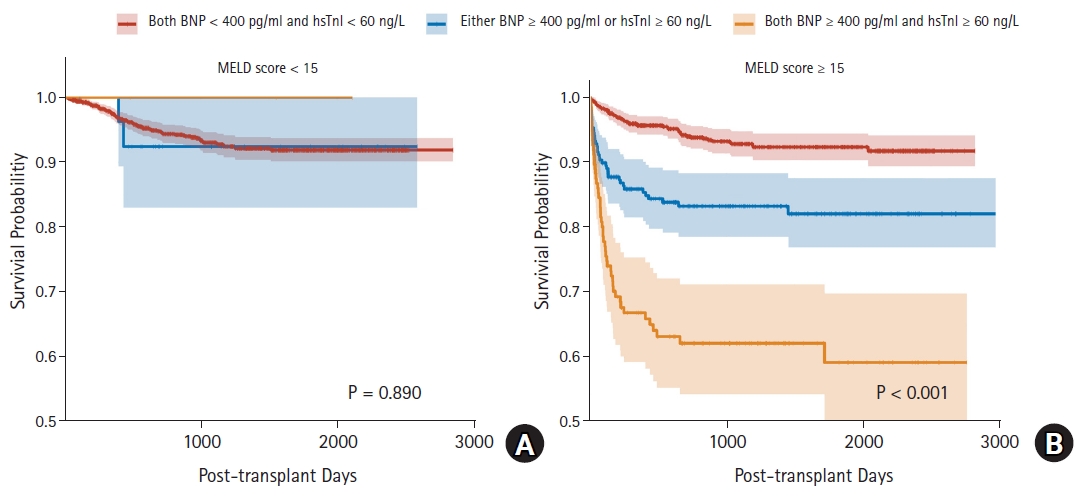
Using a combination of two cut-off values: both decreased, either one elevated, or both elevated, three subsets were generated and patients’ characteristics in each of them are described in Supplementary Table 1. One hundred and thirty-nine patients (5.6%) were in the subset with both elevated, 267 (10.7%) were in the subset with either one elevated, and 2,084 (83.7%) were in the subset with both decreased. The subset with both elevated (BNP ≥ 400 pg/ml and hsTnI ≥ 60 ng/L) showed higher MELD scores and suffered more severe hepatic comorbidities compared with the subset with both decreased (Supplementary Table 1). They exhibited higher crude and adjusted HRs of 21.19 (11.98, 37.48; P < 0.001) and 4.23 (1.98, 9.03; P < 0.001), respectively, compared with that with both decreased (Table 2).
Specifically, when patients are dichotomized by liver disease severity using the MELD score, clear separation of Kaplan-Meier survival curves for mortality depending on the particular combination of BNP and hsTnI values was demonstrated. The number of deaths that occurred in the subset with MELD scores ≥ 15 was greater than the number in the subset with MELD scores < 15 (Fig. 3). Importantly, most of the deaths occurred within 1 year in patients with both biomarkers elevated. Among patients with MELD score ≥ 15, the 90-day mortality rates were 19.9% for patients with both cardiac biomarkers elevated and 1.7% for those with both cardiac biomarkers decreased. Both cardiac biomarkers showed significant correlations with MELD scores, with more wide distribution among higher MELD scores (Supplementary Fig. 1). For 1,367 patients with low MELD score (< 15), only 0.2% of the patients showed both BNP and hsTnI elevated, whereas 98.2% of them had neither elevated BNP nor elevated hsTnI above the cut-off values.
Restricted cubic spline analysis showing the hazard ratio of 90-day mortality with preoperative BNP on a continuous scale, with BNP 400 pg/ml as the reference value, grouped by a cut-off value for hsTnI of 60 ng/L is shown in Fig. 4.
Discussion
In the present study, we provide evidence supporting the feasibility of risk stratification using both cardiac biomarkers (BNP and hsTnI) concomitantly before LT surgery. The early 90-day mortality rate is clearly stratified into broad levels according to the combinations of preoperative BNP and hsTnI values, particularly among those with advanced liver cirrhosis with high MELD scores. The main findings of the present study were: (1) There was a significant correlation between BNP and hsTnI (r = 0.567, P < 0.001) in LT candidates; non-survivors, in particular, showed a stronger correlation, which implies that more myocardial injury might be imposed on elevated cardiac strain when compared with survivors (r = 686 vs. 0.472, interaction P < 0.001). (2) The best cut-off values of BNP and hsTnI for mortality prediction were 400 pg/ml and 60 ng/L (i.e., 1.5 times 99th percentile URL), respectively. (3) A half of those who had BNP ≥ 400 pg/ml are further stratified into having hsTnI ≥ 60 ng/L. (4) Using these cut-off values, patients with elevation of both BNP and hsTnI had a markedly greater risk of early 90-day mortality (19.4%) than those with elevation of either (9.0%) or neither (1.0%) of these 2 biomarkers; this result was profound in patients with MELD score ≥ 15.
In the present study, there was a significant correlation between BNP and hsTnI and this correlation was stronger in non-survivors. Approximately one half of patients (50.9%) with BNP ≥ 400 pg/ml had elevation of hsTnI ≥ 60 ng/L; in contrast, only 6% of patients with BNP < 400 pg/ml had hsTnI ≥ 60 ng/L. These findings suggest that release of hsTnI and BNP might be associated with each other and hsTnI release is activated partly by the increased cardiac strain (reflected by the high BNP) in response to various pathophysiological changes and/or stimuli of advanced liver disease, although the exact mechanism is unclear. It has been known that the physiological stimuli for myocardial production of BNP are an increase in preload and afterload and possibly myocardial ischemia [31,32]; further study will be needed to clarify their role in LT candidates. Indeed, 5.6% patients with both elevated BNP (≥ 400 pg/ml) and hsTnI (≥ 60 ng/L) showed higher MELD scores and suffered more severe comorbidities of advanced liver disease, such as renal replacement therapy, hepatic encephalopathy, and spontaneous bacterial peritonitis, compared with those with both biomarkers decreased (Supplementary Table 1).
We found that the effect of elevation of both cardiac biomarkers was more pronounced among patients with advanced cirrhosis, that is, those with a MELD score ≥ 15. Among patients with a low MELD score, the proportion of elevation of both BNP and hsTnI was small and did not make any difference in mortality rate. When coupled with high MELD score ≥ 15, the 90-day mortality rate of patients with concomitantly elevated cardiac biomarkers was over 10 times higher than that of patients with normal cardiac biomarkers (19.9% vs. 1.7%). This implies that the risk stratification using the combination of those cardiac biomarkers is more effective in more advanced end-stage liver disease patients. It is well known that LT is one of the high-risk non-cardiac surgical procedures, involving massive hemorrhage and inferior vena cava clamping. In addition, dynamic circulation, loss of systemic vascular resistance, need for higher cardiac output, and low hemoglobin, all features of severe end-state liver disease patients, might cause biomarker elevation. And it is often difficult to maintain the vital signs stable without maximized volume resuscitation, which can result in cardiac strain. All those possible causes for pre-LT cardiac biomarker elevation are more pronounced in severe end-state liver disease state, which is well reflected by the higher MELD score. For 1,367 patients with low MELD score (< 15), our data showed that only 0.2% of the patients had elevated levels of both BNP and hsTnI, whereas 98.2% of them had neither elevated BNP nor elevated hsTnI above the cut-off values. Therefore, the clinical practice of measuring cardiac biomarkers in those with higher MELD score, which might go unnoticed without monitoring, is clearly recommended based on the current study results.
Circulating BNP, which is secreted into the circulation in response to increased cardiac wall stress, has been widely used in cardiology as a prognostic and diagnostic biomarker. Additionally, multiple studies have demonstrated that elevated preoperative BNP concentrations are independent predictors of perioperative cardiovascular mortality and morbidity [33,34]. Nevertheless, optimal data are still not available for LT surgery and only a few studies with small cohorts attempted to specify the cut-off values. It has been reported that the cut-off value of pre-LT BNP for predicting 180-day mortality was 155 pg/ml (n = 207) [35]. Another study (n = 104) demonstrated a BNP level of 100 pg/ml as a cut-off value for predicting early allograft dysfunction [29]. On the other hand, in the 30,487 patients’ data from the Vanderbilt University Medical Center electronic health record, the risk of death was similar regardless of whether patients had heart failure or not when the BNP level was sufficiently high. Namely, a BNP level of 400 pg/ml was associated with a three-year risk of death of 21% (95% CI, 20%, 23%) in patients with heart failure and 19% (95% CI, 17%, 20%) in those without [30]. In the present study, with a large LT cohort (n = 2,490), the statistically derived optimal cut-off value for the prediction of mortality was also close to 400 pg/ml (325 pg/ml for 90-day mortality and 442 pg/ml for overall mortality during the follow-up period).
Elevated cardiac troponin I levels have been traditionally associated with myocyte necrosis and myocardial infarction. With the development of high-sensitivity assay, it is now possible to detect myocardial injury at an earlier stage. We found that 344 patients (13.8%) exceeded the 99th percentile URL. However, the reference ranges of 99th percentile URL used for diagnosis of myocardial injury in a healthy population may not have equal predictive value for overall early mortality in LT surgery patients [36]. Hitherto, there are no known reference values for this atypical sub-population. In the current study, we provide the best cut-off value of 60 ng/L in LT candidates, which is 1.5 times the 99th percentile URL, and 10.8% of patients exceeded this cut-off value preoperatively.
With rising prevalence of CAD in LT candidates, patients with a previous history of percutaneous coronary intervention or coronary artery bypass surgery are also increasing. In the current study, such patients showed slightly higher baseline hsTnI concentration, but the proportion of patients exceeding the 99th percentile URL and 90-day mortality was not statistically different from those without a history of treatment of ischemic heart disease. We assume that the elevation of cardiac biomarkers, especially troponin, may be more related to type II myocardial infarction from supply/demand mismatch than type I classical myocardial infarction caused by plaque rupture of coronary arteries. This finding suggests that measurement of hsTnI and BNP before LT might be more important than the history of CAD itself.
Our study has several limitations. First, with its retrospective design, which may have selection bias, this study included a heterogeneous group of patients, which may have affected biomarker results and transplant outcomes. However, our current study cohort was large and included consecutive patients who had hsTnI and BNP measurement during routine preoperative and postoperative workups and we provided multivariable adjusted HR. Nevertheless, prospective randomized control studies are needed to validate our results. Second, we evaluated the cardiac biomarkers only within a week before LT. Considering the frequent incidence of hemodynamic instability in LT candidates, a kinetic analysis of serial cardiac biomarker levels would be more informative. Because of the necessity to exercise caution in drawing conclusions from a single study, future studies on the serial analysis of perioperative cardiac biomarkers are warranted. Third, our data were based on the characteristics of patients from a single, large-volume center. Studies including multicenter records that include patients of different ethnicities and backgrounds are therefore needed. Fourth, we do not include data on frailty. Because the field of frailty has only recently been highlighted, our data, which include almost 10 years of consecutive LT, could not cover those functional aspects of LT recipients. However, although there is a rapidly growing body of evidence supporting the association between frailty and harmful outcome after LT [37,38], the consensus on its definition, tools for assessment, and implication for transplant seems not to be established yet [39]. Fifth, our study evaluated cardiac biomarkers only measured within a week before transplant. Most of them are measured just a day before transplant. We used very recent cardiac biomarker values to avoid confounding factors between their measurement and surgery as much as possible. Thus, it may not be reasonable to apply our data result directly into the listing system for cadaveric transplant, where the time course takes weeks and months. Although we demonstrated a clear relationship between hsTnI elevation within a week before transplant and poor outcome, we do not know whether the prognosis difference exists between remote and immediate event(s) of preoperative myocardial injury/strain. As reported in a recent study, there is a possibility that longer duration between cardiac biomarker elevation and surgery might reduce the risk of adverse events [40]. Further studies with more frequent measurement of cardiac biomarkers in liver transplantation recipients should be conducted to discuss whether delaying (or even delisting) of those patients is needed. In addition, appropriate management strategies should be sought to minimize the postoperative risk of adverse outcome.
In conclusion, patients with myocardial injury (high hsTnI) in advanced liver disease with elevated cardiac strain (high BNP) had poorer survival after LT. Therefore, the combined use of preoperative BNP and hsTnI would help to recognize high-risk patients for predicting 90-day mortality after LT, especially in those with advanced MELD score. We recommend the routine monitoring of these two biomarkers in at-risk patients to enhance risk stratification of mortality in LT candidates and help administer target therapies that could modify early mortality.



 PDF Links
 PubReader
 ePub Link
 XML Download
 Full text via DOI
 Download Citation
 Supplement1
 Print
Print